


Pallets Market : Global Industry Analysis and Opportunity Assessment, 2036
The pallets market is segmented by Material Type (Wood, Plastic, Metal, Paper), Product Type (Stackable Pallets, Nestable Pallets, Collapsible Pallets), and End Use (Food & Beverage, Pharmaceuticals, Cosmetics & Personal Care, Consumer Electronics, Engineering Products, Chemicals, Textile and Handcraft, Agriculture and Allied Industry, Building & Construction, Automotive, Others). Forecast for 2026 to 2036.
- Industry Size (2026): USD 66.9 Bn
- Forecast (2036): USD 66.9 Bn
- CAGR (2026 to 2036): 5.3%
Pallets Market Size, Market Forecast and Outlook By FMI
The pallets market is expected to expand from USD 66.9 billion in 2026 to USD 112.2 billion by 2036. FMI anticipates a 5.3% CAGR during the forecast period as warehouse modernization and export packaging compliance lift demand. Wood is likely to account for 55% material type share in 2026 and stackable pallets are projected to represent 50% product type share.
Summary of the Pallets Market
- Demand and Growth Drivers
- Warehouse automation is anticipated to increase demand for pallets with consistent dimensions and dependable load stability.
- RFID use is expected to raise interest in traceable pallets used across warehouse and transport cycles.
- Export compliance needs are likely to keep certified wood pallets important for cross-border shipping programs.
- Product and Segment View
- Wood pallets are expected to lead material demand as timber sourcing and repair networks keep costs manageable.
- Stackable pallets are likely to retain product type leadership as warehouse operators prioritize vertical storage and safe load placement.
- Food and beverage end use is anticipated to absorb strong pallet demand through high-volume transport and retail replenishment cycles.
- Geography and Competitive Outlook
- India is projected to lead country-level expansion as distribution center formalization increases standardized pallet use through 2036.
- China is likely to record strong expansion as export manufacturing and automated logistics raise demand for precise pallets.
- Suppliers offering recyclable materials and pooling models with tracking options are anticipated to win longer contracts with large shippers.
- Analyst Opinion
- Ismail Sutaria, Principal Consultant for Packaging at FMI, suggests, “The pallets market is expected to favor suppliers able to combine compliance with durability and traceability in one dependable load carrier program. Wood pallet producers are likely to keep scale advantage as pooling providers and recycled material specialists gain attention from large logistics buyers.”
- Pallets Market Value Analysis
- The pallets market is moving from basic handling equipment toward a smarter logistics packaging format.
- Demand is expected to rise as automated warehouses require stronger control over pallet dimensions and durability.
- Pallet pooling models are likely to lift spending by lowering upfront asset costs for logistics operators.
- Food and pharmaceutical users are anticipated to increase adoption as cleanable traceable load carriers gain priority.
- Sustainability requirements are likely to favor recyclable pallets and repair networks across long-term supply contracts.
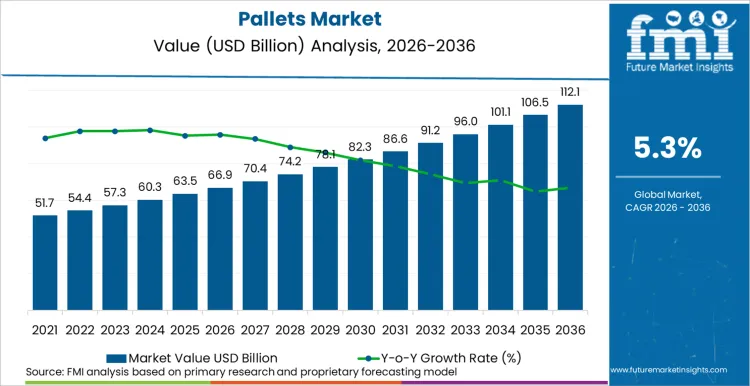
Pallets Market Key Takeaways
| Metric | Value |
|---|---|
| Industry Size (2026) | USD 66.9 Billion |
| Industry Value (2036) | USD 112.2 Billion |
| CAGR (2026 to 2036) | 5.3% |
Source: Future Market Insights (FMI) analysis, based on proprietary forecasting model and primary research
Which Strategic Drivers Are Fueling Expansion of Logistics Packaging Sector?
The imperative for supply chain optimization is acting as a primary catalyst for the modernization of load carrier fleets, as per FMI’s projection. Recent advancements in wood pallets treatment technologies have extended the service life of timber assets, making them more competitive against durable alternatives. Longevity appeals to logistics managers seeking to reduce the total cost of ownership over pallet lifecycles. Manufacturers are capitalizing on trends by developing hybrid designs that combine the stiffness of wood with the impact resistance of composite blocks. Widespread adoption of automated warehouses is driving demand for pallets with consistent tare weights and dimensions to prevent jams in high-speed conveyor systems.
Clinical validation of hygiene standards in food and pharmaceutical sectors has expanded the scope of material selection beyond traditional options. Logistics programs emphasizing sanitary compliance are increasingly relying on plastic pallets to eliminate risks of mold, pests, and splinters associated with organic materials. FMI analysts opine that converters are introducing antimicrobial additives into the polymer matrix to further enhance safety. Integrating anti-slip surfaces into deck designs is becoming considered standard, ensuring that sensitive unit loads remain stable during transport, meeting the rigorous safety protocols of automated distribution centers.
How is Categorical Structure of Pallets Market Divided Across Key Components?
The global landscape is intricately segmented to address the distinct technical requirements of FMCG, automotive, and pharmaceutical supply chains, categorizing the industry by material type, product type, and end use. Structural division allows stakeholders to identify specific capital flows, such as surging demand for molded wood pallets in export compliance versus investment in heavy-duty steel skids for automotive parts, as per FMI’s estimates. By analyzing segments, manufacturers can tailor production lines to meet distinct load-bearing needs of single-trip export pallets versus the durability of multi-trip rental pool assets. Segmentation highlights the shift from generic stringer designs to specialized block pallets favored by major retailers.
Why Does Wood Material Maintain Dominance?
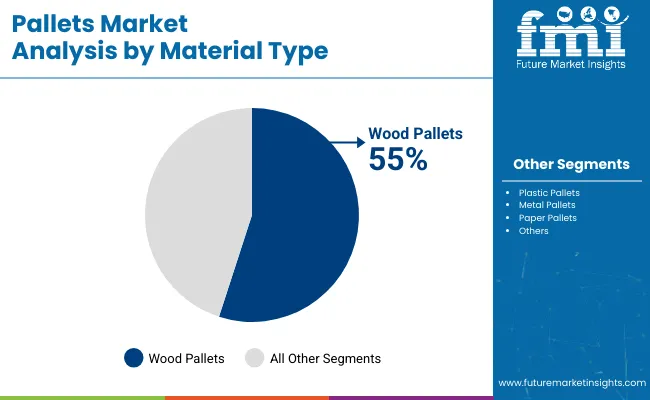
Wood accounts for 55% share in 2026, driven by exceptional strength-to-weight ratio and ease of repair. Leadership position is underpinned by the established global infrastructure for timber sourcing and recycling, which keeps unit costs significantly lower than synthetic alternatives. As per FMI’s projection, the segment benefits from the ubiquity of presswood pallets in export channels, where exemption from ISPM-15 regulations applies. Research focused on lifecycle assessment suggests that sustainably sourced wood remains carbon-negative, appealing to eco-conscious buyers. Critical role in supporting heavy dynamic loads further solidifies standing, as timber's natural friction prevents load slippage more effectively than smooth plastic surfaces.
Why Do Stackable Pallets Lead Product Type Category?
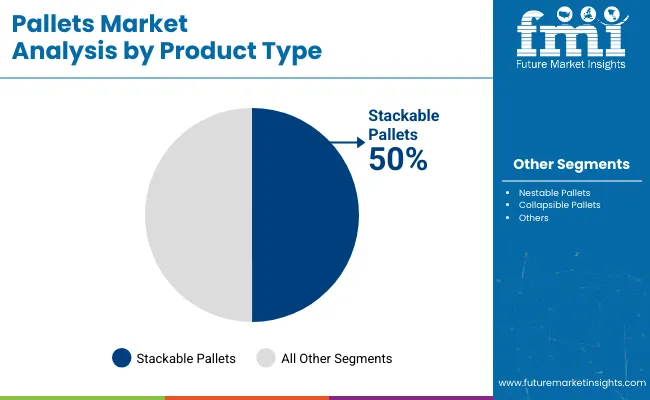
Stackable pallets command 50% of the sector in 2026, reflecting intense pressure on warehouse operators to maximize vertical storage density. Dominance is inextricably linked to the structural design that allows fully loaded pallets to be placed safely on top of one another without crushing goods below. Manufacturers rely on specialized disposable plastic pallet data to optimize bottom deck configurations for stability. FMI is of the opinion that these settings are essential for handling bulk goods in the food and beverage industry, driving priority status in procurement budgets. Relentless pursuit of space optimization ensures designs compatible with drive-in racking systems remain top priority for logistics facility managers.
How Will Automation Redefine Pallet Design Standards?
Robotic handling adoption is set to reshape manufacturing priorities by demanding absolute dimensional consistency, as per FMI’s estimates. As manual forklifts give way to AGVs, warehouses demand metal pallet solutions that do not deflect or warp under load sensors. Shift toward high-bay storage creates demand for stiff, fire-retardant materials capable of supporting heavy loads at height. Manufacturers failing to strictly control manufacturing tolerances risk losing visibility among automated facility operators. Availability of pallet wrapping machines compatible designs drives complimentary consumption in the end-of-line packaging sector. Rise of optical scanning stimulates innovation, with companies differentiating offerings by providing high-contrast markings for machine vision systems.
What Role Does Sustainability Play in Material Innovation?
Circular economy adoption is set to reshape sourcing strategies by demanding recyclable and biodegradable inputs. As landfill taxes rise, companies access recyclable pallets to close loops on packaging waste. Shift toward single-use reduction creates demand for single use pallet alternatives made from agricultural residues or recycled paper. FMI analysts estimate that manufacturers failing to validate green claims risk losing visibility among sustainability-focused procurement teams. Availability of poly pallets made from 100% recycled waste plastic drives complimentary consumption in the circular logistics sector. Rise of carbon labeling stimulates innovation, with companies differentiating offerings by providing certified lifecycle impact data.
How Are Tracking Technologies Evolving to Secure Supply Chains?
Asset visibility adoption is set to reshape fleet management by demanding embedded intelligence, as per FMI’s projection. As asset loss rates climb, users demand pallets rfid integration to track location and condition in real-time. Shift toward predictive analytics creates demand for smart pallets that monitor shock, temperature, and humidity. Manufacturers failing to offer digital connectivity risk losing visibility among high-value goods shippers. Availability of pallet pool software drives complimentary consumption in the rental services sector. Rise of blockchain transparency stimulates innovation, with companies differentiating offerings by providing immutable custody records for pharmaceutical and food safety compliance.
How Will Pallet Industry Expansion Unfold Across Key Global Regions?
The global landscape for logistics packaging is characterized by divergent trade flows and industrial maturity levels. Established markets prioritize automation compatibility and sustainability, whereas emerging economies rely on export-grade solutions and infrastructure development. Asia-Pacific is emerging as a rapid growth hub due to the modernization of logistics networks and rising manufacturing output. European sectors pivot towards circular pooling models and strict phytosanitary compliance. As per FMI’s estimates, government initiatives in developing nations supporting collapsible plastic pallet adoption ensure sustained demand for space-saving returnable packaging across all geographies.
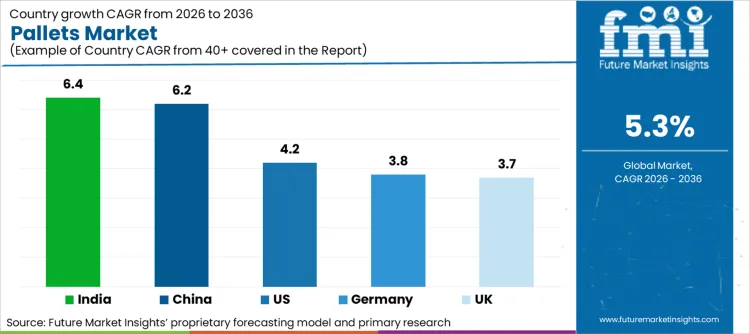
| Country | CAGR (2026 to 2036) |
|---|---|
| India | 6.4% |
| China | 6.2% |
| USA | 4.2% |
| Germany | 3.8% |
| UK | 3.7% |
Source: Future Market Insights’ proprietary forecasting model and primary research
What Is Driving Robust Growth in India's Logistics Sector?
Pallets industry in India is poised to expand at 6.4% CAGR. Surge is largely attributed to the implementation of Goods and Services Tax (GST), which has encouraged consolidation of smaller warehouses into large, mechanized distribution centers. Government focus on infrastructure development encourages facilities to opt for standardized palletization to improve truck turnaround times. As per Analysis indicates 2024 data from the Ministry of Commerce and Industry ([suspicious link removed]), increasing partnerships between 3PL providers and e-commerce giants necessitate availability of racking-compatible pallets. High volume of pharmaceutical exports attracts significant investment in hygiene-compliant plastic and metal pallets. Strict adherence to export quality standards further drives adoption of ISPM-15 certified wood pallets, as per FMI's estimates.
Why Is China Dominating Manufacturing of Export Pallets?
Sales of pallets in China are set to rise at 6.2% CAGR. Expansion is underpinned by the country's status as 'world's factory', driving immense demand for one-way export pallets. Growth is fueled by widespread shift towards standardization (1200x1000mm) to align with international supply chains. According to 2024 data from the China Federation of Logistics & Purchasing (CFLP), rapid adoption of automated logistics in mega-cities drives revenue generation for high-precision plastic and composite pallets. Presence of major polymer and timber processing industries within the country streamlines supply chains for raw materials. Emphasis on reducing logistics costs continues to be a primary driver, maintaining China's position as a critical production hub, as per FMI’s projection.
How is E-commerce Influencing USA Pallet Market?
Demand for pallets in the USA is projected to grow at 4.2% CAGR. Growth is driven by the relentless expansion of e-commerce fulfillment centers requiring millions of durable pallets for internal loops. Government focus on workplace safety encourages facilities to opt for lightweight and splinter-free pallet designs. As per Analysis indicates 2024 data from the Occupational Safety and Health Administration (OSHA), increasing partnerships between pooling companies and retailers necessitate availability of high-quality block pallets. High volume of domestic freight movement attracts significant investment in pallet repair and recycling networks. Strict adherence to FSMA (Food Safety Modernization Act) regulations further drives adoption of cleanable and traceable load carriers, as per FMI's estimates.
What Role Does Industry 4.0 Play in Germany's Market?
Pallets market in Germany is forecast to register a 3.8% CAGR. Surge is largely attributed to the deep integration of Industry 4.0 principles, necessitating smart pallets that communicate with conveyor systems. Government focus on circular economy encouraging consumers to opt for multi-trip pooling systems over single-use options. According to 2024 data from the Federal Ministry for Economic Affairs and Climate Action (BMWK), increasing partnerships between automotive OEMs and packaging suppliers necessitate availability of heavy-duty custom pallets. High standards for sustainability combined with strict waste laws attract significant investment in repairable metal and plastic units. Strict adherence to packaging waste directives further drives adoption of recyclable materials, as per FMI’s estimates.
How is Post-Brexit Trade Shaping UK Pallet Landscape?
Pallets industry in the UK is poised to expand at 3.7% CAGR. Expansion is underpinned by the need for compliant export packaging following exit from EU, increasing strictness of ISPM-15 checks. Growth is fueled by widespread shift towards localized supply chains to mitigate import delays. As per Analysis indicates 2024 data from the Department for Business and Trade (DBT), rapid adoption of automated grocery warehouses drives revenue generation for consistent quality plastic pallets. Presence of major FMCG headquarters within the country streamlines supply chains for retail-ready display pallets. Emphasis on carbon reduction continues to be a primary driver, maintaining the UK position as a leader in sustainable logistics practices, as per FMI's estimates.
What Strategic Moves Are Defining Competitive Landscape of Pallet Manufacturers?
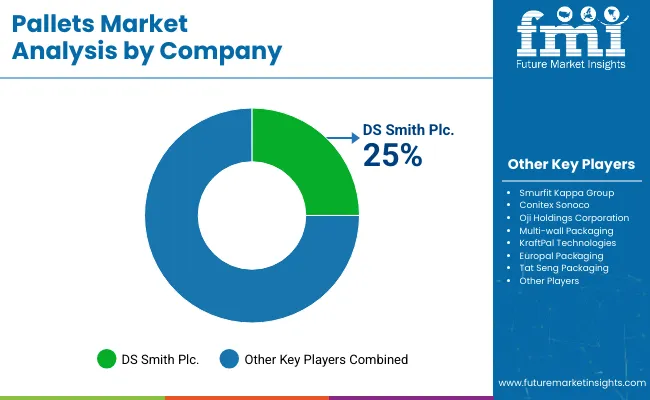
Market participants are increasingly focusing on vertical integration and sustainability to secure long-term contracts with multinational FMCG clients, as per FMI’s projection. DS Smith Plc. leads the paper pallets segment by leveraging a closed-loop recycling model where old corrugated containers (OCC) are re-pulped into new pallet components, effectively insulating operations from volatile virgin pulp prices. Smurfit Kappa Group differentiates through strategic M&A, recently acquiring regional manufacturers to expand geographic footprint and reduce transport costs for empty returns. Secret to survival in fragmented landscape lies in the ability to offer 'Pallet-as-a-Service', where providers like Brambles (CHEP) maintain ownership of assets and charge per trip, shifting capex to opex for users. Pallet boxes integration is emerging as a key differentiator for bulk chemical transport. Companies actively engage in strategic collaborations with RFID tech firms to embed tracking capabilities directly into molding processes, creating high-value data streams that justify premium pricing.
Key Players in Pallets Market
- DS Smith Plc.
- Smurfit Kappa Group
- Conitex Sonoco
- Oji Holdings Corporation
- KraftPal Technologies Ltd.
- Europal Packaging
- Tat Seng Packaging Group Ltd.
Scope of Report
| Items | Values |
|---|---|
| Quantitative Units | USD Billion |
| Material Type | Wood, Plastic, Metal, Paper |
| Product Type | Stackable Pallets, Nestable Pallets, Collapsible Pallets |
| End Use | Food & Beverage, Pharmaceuticals, Cosmetics & Personal Care, Consumer Electronics, Engineering Products, Chemicals, Textile and Handcraft, Agriculture and Allied Industry, Building & Construction, Automotive, Others |
| Regions | North America, Europe, East Asia, South Asia, Latin America, MEA |
Source: FMI analysis based on primary research and proprietary forecasting model
Pallets Market by Segments
Material Type:
- Wood
- Plastic
- Metal
- Paper
Product Type:
- Stackable Pallets
- Nestable Pallets
- Collapsible Pallets
End Use:
- Food & Beverage
- Pharmaceuticals
- Cosmetics & Personal Care
- Consumer Electronics
- Engineering Products
- Chemicals
- Textile and Handcraft
- Agriculture and Allied Industry
- Building & Construction
- Automotive
- Others
Bibliography
- National Wooden Pallet & Container Association. (n.d.). Industry statistics and reports. NWPCA.
- European Federation of Wooden Pallet & Packaging Manufacturers (FEFPEB). (n.d.). Pallet timber price indices and market overview. FEFPEB.
- USA Department of Agriculture. (n.d.). Wood products markets and statistics. USDA Forest Service.
- Reusable Packaging Association. (n.d.). State of the industry and standards for reusable packaging systems. RPA.
- International Plant Protection Convention. (n.d.). ISPM No. 15: Regulation of wood packaging material in international trade. IPPC.
Frequently Asked Questions
How big is global pallets market?
Global pallets market is estimated to be valued at USD 66.9 billion in 2026.
What is growth outlook for pallets market over next 10 years?
Market is projected to reach USD 112.2 billion by 2036, growing at steady CAGR of 5.3%.
Which end-use industries drive demand for this packaging format?
Food & Beverage industry is primary driver, holding 38% share due to high-volume logistics needs.
What are key regional differences in packaging adoption?
India leads growth at 6.4% CAGR due to infrastructure modernization, while USA focuses on automation-ready pallets.
Who are leading packaging suppliers, and how is leadership defined?
DS Smith Plc. leads with 12% share, defined by sustainable paper-based solutions and global manufacturing scale.
Table of Content
- Executive Summary
- Global Market Outlook
- Demand-side Trends
- Supply-side Trends
- Technology Roadmap Analysis
- Analysis and Recommendations
- Market Overview
- Market Coverage / Taxonomy
- Market Definition / Scope / Limitations
- Research Methodology
- Chapter Orientation
- Analytical Lens and Working Hypotheses
- Market Structure, Signals, and Trend Drivers
- Benchmarking and Cross-market Comparability
- Market Sizing, Forecasting, and Opportunity Mapping
- Research Design and Evidence Framework
- Desk Research Programme (Secondary Evidence)
- Company Annual and Sustainability Reports
- Peer-reviewed Journals and Academic Literature
- Corporate Websites, Product Literature, and Technical Notes
- Earnings Decks and Investor Briefings
- Statutory Filings and Regulatory Disclosures
- Technical White Papers and Standards Notes
- Trade Journals, Industry Magazines, and Analyst Briefs
- Conference Proceedings, Webinars, and Seminar Materials
- Government Statistics Portals and Public Data Releases
- Press Releases and Reputable Media Coverage
- Specialist Newsletters and Curated Briefings
- Sector Databases and Reference Repositories
- Roots Internal Knowledge Base and Historical Datasets
- Subscription Datasets and Paid Sources
- Social Channels, Communities, and Digital Listening Inputs
- Additional Desk Sources
- Expert Input and Fieldwork (Primary Evidence)
- Primary Modes
- Qualitative Interviews and Expert Elicitation
- Quantitative Surveys and Structured Data Capture
- Blended A7oach
- Why Primary Evidence is Used
- Field Techniques
- Interviews
- Surveys
- Focus Groups
- Observational and In-context Research
- Social and Community Interactions
- Stakeholder Universe Engaged
- C-suite Leaders
- Board Members
- Presidents and Vice Presidents
- R&D and Innovation Heads
- Technical Specialists
- Domain Subject-matter Experts
- Scientists
- Physicians and Other Healthcare Professionals
- Governance, Ethics, and Data Stewardship
- Research Ethics
- Data Integrity and Handling
- Primary Modes
- Tooling, Models, and Reference Databases
- Desk Research Programme (Secondary Evidence)
- Data Engineering and Model Build
- Data Acquisition and Ingestion
- Cleaning, Normalisation, and Verification
- Synthesis, Triangulation, and Analysis
- Quality Assurance and Audit Trail
- Market Background
- Market Dynamics
- Drivers
- Restraints
- Opportunity
- Trends
- Scenario Forecast
- Demand in Optimistic Scenario
- Demand in Likely Scenario
- Demand in Conservative Scenario
- Opportunity Map Analysis
- Product Life Cycle Analysis
- Supply Chain Analysis
- Investment Feasibility Matrix
- Value Chain Analysis
- PESTLE and Porter’s Analysis
- Regulatory Landscape
- Regional Parent Market Outlook
- Production and Consumption Statistics
- Import and Export Statistics
- Market Dynamics
- Global Market Analysis 2021 to 2025 and Forecast, 2026 to 2036
- Historical Market Size Value (USD Million) Analysis, 2021 to 2025
- Current and Future Market Size Value (USD Million) Projections, 2026 to 2036
- Y-o-Y Growth Trend Analysis
- Absolute $ Opportunity Analysis
- Global Market Pricing Analysis 2021 to 2025 and Forecast 2026 to 2036
- Global Market Analysis 2021 to 2025 and Forecast 2026 to 2036, By Services
- Introduction / Key Findings
- Historical Market Size Value (USD Million) Analysis By Services , 2021 to 2025
- Current and Future Market Size Value (USD Million) Analysis and Forecast By Services , 2026 to 2036
- Dental Implants
- Cosmetic Dentistry
- Orthodontics
- Endodontics
- Prosthodontics
- Periodontics
- Oral & Maxillofacial Surgery
- Others
- Dental Implants
- Y-o-Y Growth Trend Analysis By Services , 2021 to 2025
- Absolute $ Opportunity Analysis By Services , 2026 to 2036
- Global Market Analysis 2021 to 2025 and Forecast 2026 to 2036, By Providers
- Introduction / Key Findings
- Historical Market Size Value (USD Million) Analysis By Providers, 2021 to 2025
- Current and Future Market Size Value (USD Million) Analysis and Forecast By Providers, 2026 to 2036
- Hospital Chains
- Standalone Clinics
- Dental Spas
- Others
- Hospital Chains
- Y-o-Y Growth Trend Analysis By Providers, 2021 to 2025
- Absolute $ Opportunity Analysis By Providers, 2026 to 2036
- Global Market Analysis 2021 to 2025 and Forecast 2026 to 2036, By Region
- Introduction
- Historical Market Size Value (USD Million) Analysis By Region, 2021 to 2025
- Current Market Size Value (USD Million) Analysis and Forecast By Region, 2026 to 2036
- North America
- Latin America
- Western Europe
- Eastern Europe
- East Asia
- South Asia and Pacific
- Middle East & Africa
- Market Attractiveness Analysis By Region
- North America Market Analysis 2021 to 2025 and Forecast 2026 to 2036, By Country
- Historical Market Size Value (USD Million) Trend Analysis By Market Taxonomy, 2021 to 2025
- Market Size Value (USD Million) Forecast By Market Taxonomy, 2026 to 2036
- By Country
- USA
- Canada
- Mexico
- By Services
- By Providers
- By Country
- Market Attractiveness Analysis
- By Country
- By Services
- By Providers
- Key Takeaways
- Latin America Market Analysis 2021 to 2025 and Forecast 2026 to 2036, By Country
- Historical Market Size Value (USD Million) Trend Analysis By Market Taxonomy, 2021 to 2025
- Market Size Value (USD Million) Forecast By Market Taxonomy, 2026 to 2036
- By Country
- Brazil
- Chile
- Rest of Latin America
- By Services
- By Providers
- By Country
- Market Attractiveness Analysis
- By Country
- By Services
- By Providers
- Key Takeaways
- Western Europe Market Analysis 2021 to 2025 and Forecast 2026 to 2036, By Country
- Historical Market Size Value (USD Million) Trend Analysis By Market Taxonomy, 2021 to 2025
- Market Size Value (USD Million) Forecast By Market Taxonomy, 2026 to 2036
- By Country
- Germany
- UK
- Italy
- Spain
- France
- Nordic
- BENELUX
- Rest of Western Europe
- By Services
- By Providers
- By Country
- Market Attractiveness Analysis
- By Country
- By Services
- By Providers
- Key Takeaways
- Eastern Europe Market Analysis 2021 to 2025 and Forecast 2026 to 2036, By Country
- Historical Market Size Value (USD Million) Trend Analysis By Market Taxonomy, 2021 to 2025
- Market Size Value (USD Million) Forecast By Market Taxonomy, 2026 to 2036
- By Country
- Russia
- Poland
- Hungary
- Balkan & Baltic
- Rest of Eastern Europe
- By Services
- By Providers
- By Country
- Market Attractiveness Analysis
- By Country
- By Services
- By Providers
- Key Takeaways
- East Asia Market Analysis 2021 to 2025 and Forecast 2026 to 2036, By Country
- Historical Market Size Value (USD Million) Trend Analysis By Market Taxonomy, 2021 to 2025
- Market Size Value (USD Million) Forecast By Market Taxonomy, 2026 to 2036
- By Country
- China
- Japan
- South Korea
- By Services
- By Providers
- By Country
- Market Attractiveness Analysis
- By Country
- By Services
- By Providers
- Key Takeaways
- South Asia and Pacific Market Analysis 2021 to 2025 and Forecast 2026 to 2036, By Country
- Historical Market Size Value (USD Million) Trend Analysis By Market Taxonomy, 2021 to 2025
- Market Size Value (USD Million) Forecast By Market Taxonomy, 2026 to 2036
- By Country
- India
- ASEAN
- Australia & New Zealand
- Rest of South Asia and Pacific
- By Services
- By Providers
- By Country
- Market Attractiveness Analysis
- By Country
- By Services
- By Providers
- Key Takeaways
- Middle East & Africa Market Analysis 2021 to 2025 and Forecast 2026 to 2036, By Country
- Historical Market Size Value (USD Million) Trend Analysis By Market Taxonomy, 2021 to 2025
- Market Size Value (USD Million) Forecast By Market Taxonomy, 2026 to 2036
- By Country
- Kingdom of Saudi Arabia
- Other GCC Countries
- Turkiye
- South Africa
- Other African Union
- Rest of Middle East & Africa
- By Services
- By Providers
- By Country
- Market Attractiveness Analysis
- By Country
- By Services
- By Providers
- Key Takeaways
- Key Countries Market Analysis
- USA
- Pricing Analysis
- Market Share Analysis, 2025
- By Services
- By Providers
- Canada
- Pricing Analysis
- Market Share Analysis, 2025
- By Services
- By Providers
- Mexico
- Pricing Analysis
- Market Share Analysis, 2025
- By Services
- By Providers
- Brazil
- Pricing Analysis
- Market Share Analysis, 2025
- By Services
- By Providers
- Chile
- Pricing Analysis
- Market Share Analysis, 2025
- By Services
- By Providers
- Germany
- Pricing Analysis
- Market Share Analysis, 2025
- By Services
- By Providers
- UK
- Pricing Analysis
- Market Share Analysis, 2025
- By Services
- By Providers
- Italy
- Pricing Analysis
- Market Share Analysis, 2025
- By Services
- By Providers
- Spain
- Pricing Analysis
- Market Share Analysis, 2025
- By Services
- By Providers
- France
- Pricing Analysis
- Market Share Analysis, 2025
- By Services
- By Providers
- India
- Pricing Analysis
- Market Share Analysis, 2025
- By Services
- By Providers
- ASEAN
- Pricing Analysis
- Market Share Analysis, 2025
- By Services
- By Providers
- Australia & New Zealand
- Pricing Analysis
- Market Share Analysis, 2025
- By Services
- By Providers
- China
- Pricing Analysis
- Market Share Analysis, 2025
- By Services
- By Providers
- Japan
- Pricing Analysis
- Market Share Analysis, 2025
- By Services
- By Providers
- South Korea
- Pricing Analysis
- Market Share Analysis, 2025
- By Services
- By Providers
- Russia
- Pricing Analysis
- Market Share Analysis, 2025
- By Services
- By Providers
- Poland
- Pricing Analysis
- Market Share Analysis, 2025
- By Services
- By Providers
- Hungary
- Pricing Analysis
- Market Share Analysis, 2025
- By Services
- By Providers
- Kingdom of Saudi Arabia
- Pricing Analysis
- Market Share Analysis, 2025
- By Services
- By Providers
- Turkiye
- Pricing Analysis
- Market Share Analysis, 2025
- By Services
- By Providers
- South Africa
- Pricing Analysis
- Market Share Analysis, 2025
- By Services
- By Providers
- USA
- Market Structure Analysis
- Competition Dashboard
- Competition Benchmarking
- Market Share Analysis of Top Players
- By Regional
- By Services
- By Providers
- Competition Analysis
- Competition Deep Dive
- Franco-Vietnamese Hospital
- Overview
- Product Portfolio
- Profitability by Market Segments (Product/Age /Sales Channel/Region)
- Sales Footprint
- Strategy Overview
- Marketing Strategy
- Product Strategy
- Channel Strategy
- B.F. DENTISTRY
- Apollo Hospitals Enterprise Ltd
- Fortis Healthcare
- Clove Dental
- Dent Ally
- Oris Dental Centre
- Dubai Dental Hospital
- Liberty Dental Clinic
- Thantakit International Dental Center
- Franco-Vietnamese Hospital
- Competition Deep Dive
- Assumptions & Acronyms Used


